



Industrial Slurry Hoses for Mining, Mineral Processing and Abrasive Material Handling
Reliable Slurry Hose Solutions for Demanding Industrial Applications
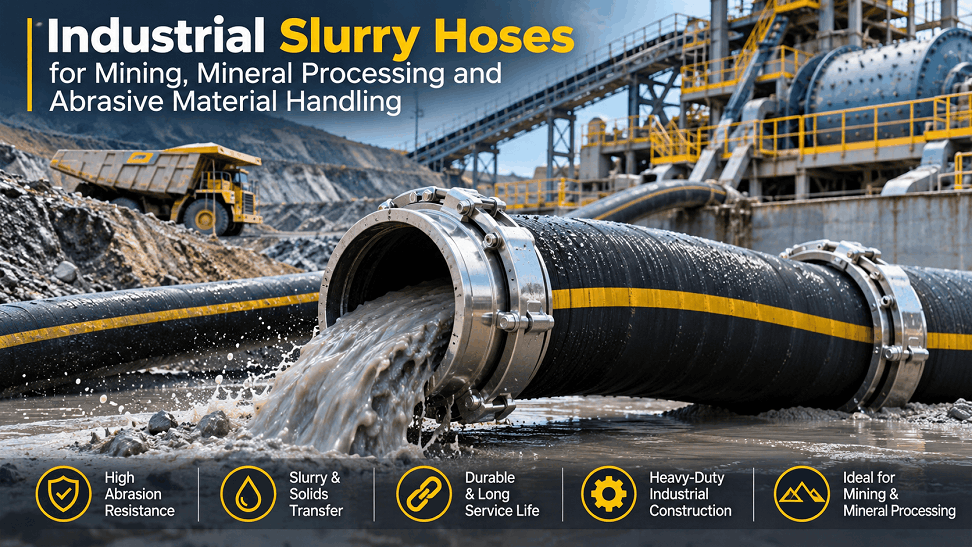
Slurry hoses are used to transfer mixtures of liquid and solid particles in applications where abrasion resistance, flexibility and reliable operation are important. They are commonly specified in mining, mineral processing, sand and aggregate production, dredging, cement plants and industrial wastewater facilities. Compared with rigid pipework, a correctly selected slurry hose can accommodate equipment movement, vibration, pipeline routing changes and connections between fixed and mobile equipment. The hose must nevertheless be selected for the actual slurry, operating pressure, temperature and installation conditions.
Slurry Hose Construction and Materials
Industrial slurry hoses are generally built with an inner tube selected to resist the conveyed material, reinforcement layers designed for the required pressure and vacuum conditions, and an outer cover intended to protect against the external environment. Natural rubber and other elastomer compounds are often used for abrasive slurry duties, while other compounds may be considered where oil, chemicals, weathering or temperature are relevant. The correct compound depends on the specific fluid chemistry and operating conditions; a generic description such as rubber-lined does not establish suitability on its own. Hose construction may include textile or wire reinforcement, depending on the pressure rating, diameter and service requirements.
Common Applications of Industrial Slurry Hoses
Slurry hoses are used for transferring mineral slurry between process equipment, connecting pumps to pipelines, handling tailings and process waste, conveying sand and gravel, supporting dredging operations and moving selected industrial sludge streams. They may be installed as suction hoses, discharge hoses or flexible connections. These duties are not interchangeable: suction service may require a hose designed to resist vacuum or collapse, while discharge service requires an appropriate working-pressure rating. Abrasion, bending, external loads and repeated movement should all be considered.
How to Select the Right Slurry Hose
Start by identifying the medium and its properties, including solids concentration, particle size, particle shape, density, temperature and chemical composition. Then confirm the required internal diameter, flow rate, working pressure, surge pressure, vacuum requirement if applicable, hose length and connection type. The routing should respect the manufacturer's minimum bend radius and avoid twisting, kinking, excessive tension or unsupported weight. Check whether the hose will be exposed to sunlight, weather, oils, chemicals, hot surfaces or mechanical impact. For critical duties, request manufacturer data covering pressure rating, vacuum capability, abrasion characteristics, temperature limits and recommended inspection or replacement criteria. End connections, clamps, flanges and couplings must be compatible with the hose design and operating conditions. A hose should not be selected by diameter alone, and its rated pressure should not be assumed to cover pressure surges or vacuum conditions unless the manufacturer confirms this.
Inspection, Maintenance and Safe Operation
Regular inspection can help identify cover damage, exposed reinforcement, bulging, leakage, coupling movement, cracking or signs of hose collapse. Inspection frequency should reflect service severity, operating cycles and the manufacturer's recommendations. Remove damaged hoses from service and investigate the cause of premature wear, such as excessive velocity, incorrect routing, unsuitable material or operating conditions outside the specified limits. Installation and maintenance should be carried out by competent personnel using approved procedures.
Slurry Hose Supply Support Across the Middle East
OXYTECHme, part of OxyMed Group, supports industrial equipment and material requirements across the UAE, Saudi Arabia, Oman, Qatar and Jordan. For slurry transfer applications in mining, mineral processing, dredging and other solids-handling industries, OXYTECHme can assist with reviewing hose requirements and coordinating suitable product options against project specifications. When requesting a quotation, provide the hose diameter, length, medium, solids characteristics, pressure, temperature, suction or discharge duty, connection details and installation environment. Contact OXYTECHme for product information, technical coordination and industrial slurry hose supply enquiries.
Contact our Specialist: technicalsales@oxymedz.com, +971 56 255 8700