
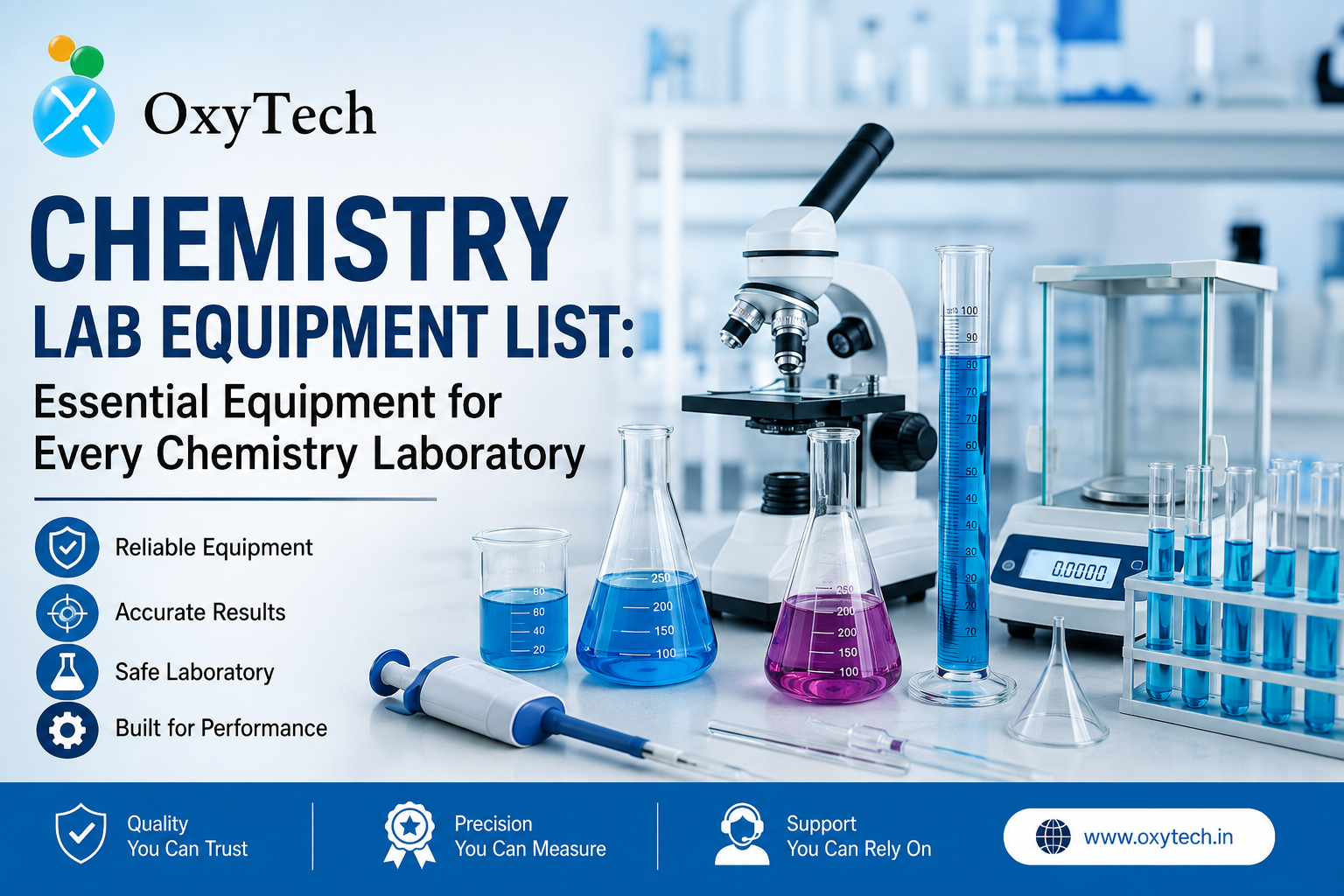
Chemistry Lab Equipment List: The Complete Guide (2026)
A chemistry lab equipment list typically includes glassware (beakers, flasks, pipettes, burettes), measuring instruments (balances, pH meters, measuring cylinders), heating and mixing tools (hot plates, magnetic stirrers, water baths), analytical instruments (spectrophotometers, centrifuges), and safety equipment (fume hoods, goggles, gloves, eyewash stations). The exact list depends on whether the lab is used for teaching, research, pharmaceutical testing, or industrial quality control.
This guide breaks down every category of equipment, explains what each tool actually does, and gives you a practical framework for choosing the right instruments for your specific lab — not just a generic checklist. OxyTech supplies and supports laboratory and scientific equipment across educational, research, pharmaceutical, and industrial settings, and the equipment guidance below reflects the kinds of specification questions labs bring to us every day.
Why Your Equipment List Should Depend on Your Lab Type
Before buying anything, the single biggest mistake labs make is copying a generic equipment list instead of matching equipment to their actual testing needs. A high school chemistry classroom, a university research lab, and a pharmaceutical QC facility need overlapping but meaningfully different tools — differing in precision, throughput, documentation requirements, and safety controls.
Use this guide in two passes:
- Skim the core equipment categories below to understand what each tool does.
- Jump to the lab-type breakdown near the end to see which combination actually applies to you.
Core Glassware: The Foundation of Every Lab
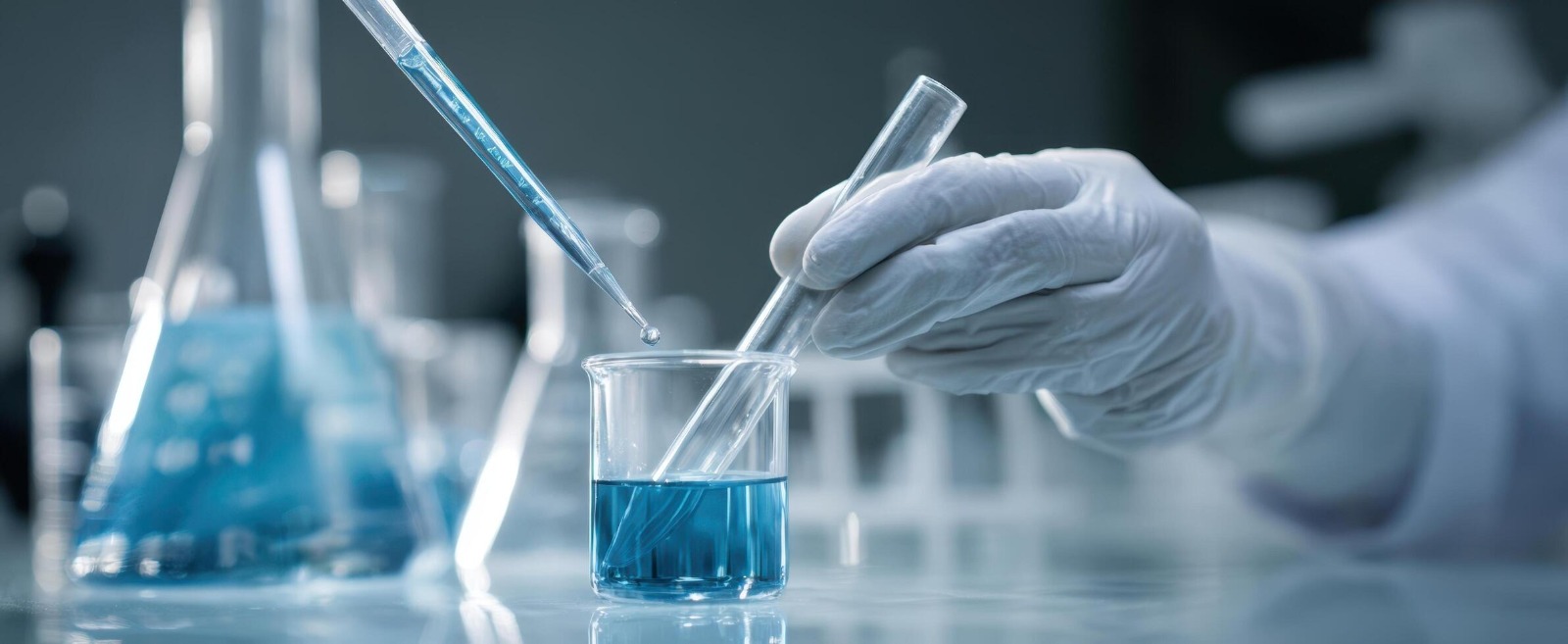
Glassware is the equipment category every chemistry lab needs regardless of size or specialty. Most labs use borosilicate glass for its resistance to thermal shock and chemical corrosion.
| Equipment | Primary Use | Precision Level |
|---|---|---|
| Beakers | Mixing, heating, holding liquids | Low (approximate markings only) |
| Erlenmeyer Flasks | Swirling/mixing without spilling | Low–Medium |
| Volumetric Flasks | Preparing exact-concentration solutions | High |
| Measuring Cylinders | General volume measurement | Medium |
| Pipettes (volumetric, graduated, micro) | Precise liquid transfer | High |
| Burettes | Controlled liquid dispensing (titration) | High |
| Test Tubes | Small-scale reactions and observation | Low |
| Funnels | Transferring or filtering liquids/powders | N/A |
| Glass Stirring Rods | Manual mixing and guiding liquid flow | N/A |
A common point of confusion: beakers and measuring cylinders are not interchangeable for anything requiring accuracy. Beakers are calibrated loosely (often ±5% or worse) and should only be used for approximate volumes — never for preparing standard solutions or reporting quantitative results. If a procedure calls for a specific concentration, use a volumetric flask or pipette instead.
Beakers
Beakers hold, mix, and heat liquids and are the most recognizable piece of lab glassware. Their graduated markings are for convenience, not accuracy — treat any beaker measurement as an estimate.
Test Tubes
Test tubes handle small-scale reactions, qualitative tests, and observation-based work like color-change or precipitation reactions. They're a staple of teaching labs because they let students run multiple small trials quickly and safely.
Erlenmeyer Flasks
The conical shape and narrow neck of an Erlenmeyer flask reduce splashing during swirling, which is why they're the standard vessel for titrations and solution mixing.
Volumetric Flasks
A volumetric flask is calibrated to hold one exact volume at one exact temperature, marked by a single etched line on the neck. Use these whenever a procedure specifies a precise concentration — they are not designed for general mixing or heating.
Measuring Cylinders (Graduated Cylinders)
Measuring cylinders offer better accuracy than beakers but less than volumetric glassware, making them the practical middle ground for routine volume measurements.
Pipettes
Pipettes transfer measured liquid volumes with high accuracy. Micropipettes (typically measuring in microliters) are essential in any lab working with small-volume biochemical or analytical samples; Pasteur pipettes are used for rough, non-quantitative transfers.
Burettes
A burette dispenses liquid drop-by-drop through a stopcock, which is what makes precise titration endpoints possible. Reliable titration results depend as much on technique — reading the meniscus at eye level, avoiding air bubbles in the tip — as on the equipment itself.
Measuring and Testing Instruments
Analytical Balances
An analytical balance measures mass with high precision (commonly to 0.0001 g), and is required wherever quantitative accuracy matters: preparing standard solutions, pharmaceutical formulation, or any calculation-based experiment. Balances should sit on a stable, vibration-free surface and be calibrated on a documented schedule — drift in a balance silently propagates errors into every result that depends on it.
pH Meters
A pH meter gives a more precise acidity/alkalinity reading than indicator paper, which matters in water testing, food science, pharmaceutical formulation, and any process sensitive to small pH shifts. Electrode care (proper storage solution, regular calibration against buffer standards) is the single biggest factor in whether pH readings stay reliable over time.
Conductivity Meters
Conductivity meters measure how well a solution carries electrical current, a common proxy for ion concentration in water-quality and process-chemistry testing.
Heating and Mixing Equipment
| Equipment | Best For | Key Consideration |
|---|---|---|
| Hot Plates | Controlled heating without an open flame | Safer around flammable solvents |
| Magnetic Stirrers | Continuous, unattended mixing | Combined stir/heat models save bench space |
| Water Baths | Gentle heating of temperature-sensitive samples | Prevents localized overheating |
| Laboratory Ovens | Drying glassware, removing moisture | Check temperature uniformity across the chamber |
| Laboratory Shakers | Controlled agitation of samples | Needed for suspension/extraction workflows |
Hot plates have largely replaced open-flame Bunsen burners in modern labs handling flammable solvents, since they remove the ignition risk while still providing controlled, adjustable heat. Magnetic stirrers, particularly combined stir/hotplate units, are now standard for any reaction that needs sustained, even mixing without a technician standing over it.
Analytical and Research-Grade Instruments
These instruments separate a basic teaching lab from a research, pharmaceutical, or industrial testing facility.
- Spectrophotometers measure how much light a sample absorbs at specific wavelengths, used for concentration determination, purity checks, and biochemical assays.
- Centrifuges separate mixture components using centrifugal force — critical for isolating solids from liquids or separating sample phases. Samples must be properly balanced before every run to avoid equipment damage.
- Gas Chromatographs (GC) separate and identify volatile compounds, common in environmental and forensic testing.
- High-Performance Liquid Chromatography (HPLC) separates, identifies, and quantifies components in liquid samples — a core instrument in pharmaceutical quality control.
- UV-Visible Spectrophotometers specifically analyze UV and visible light absorption for quantitative analysis.
- Atomic Absorption Spectrometers determine concentrations of specific metallic elements, widely used in environmental and metallurgical testing.
- Microscopes examine structures too small for the naked eye, essential in any lab doing crystallography, cell work, or particulate analysis.
Choosing among these depends on sample type, required detection limits, and throughput — not on which instrument sounds most advanced. A lab running occasional purity checks does not need the same HPLC system as a pharmaceutical facility processing hundreds of batch samples a week; OxyTech typically walks labs through this application-first fit before recommending a specific model.
Sample Handling and Storage Equipment
- Desiccators maintain a low-humidity environment (often using a drying agent like silica gel) to protect moisture-sensitive samples and reagents.
- Fume Hoods capture and exhaust hazardous vapors and fumes away from the person working at the bench — arguably the single most important piece of safety infrastructure in any lab handling volatile chemicals.
Safety Equipment: Non-Negotiable in Any Chemistry Lab
Safety equipment protects laboratory personnel and is required in every chemistry lab regardless of size or funding. A minimum safety setup includes:
- Lab coats and chemical-resistant gloves
- Safety goggles and face protection
- Fume hoods for volatile or hazardous chemical handling
- Emergency showers and eyewash stations
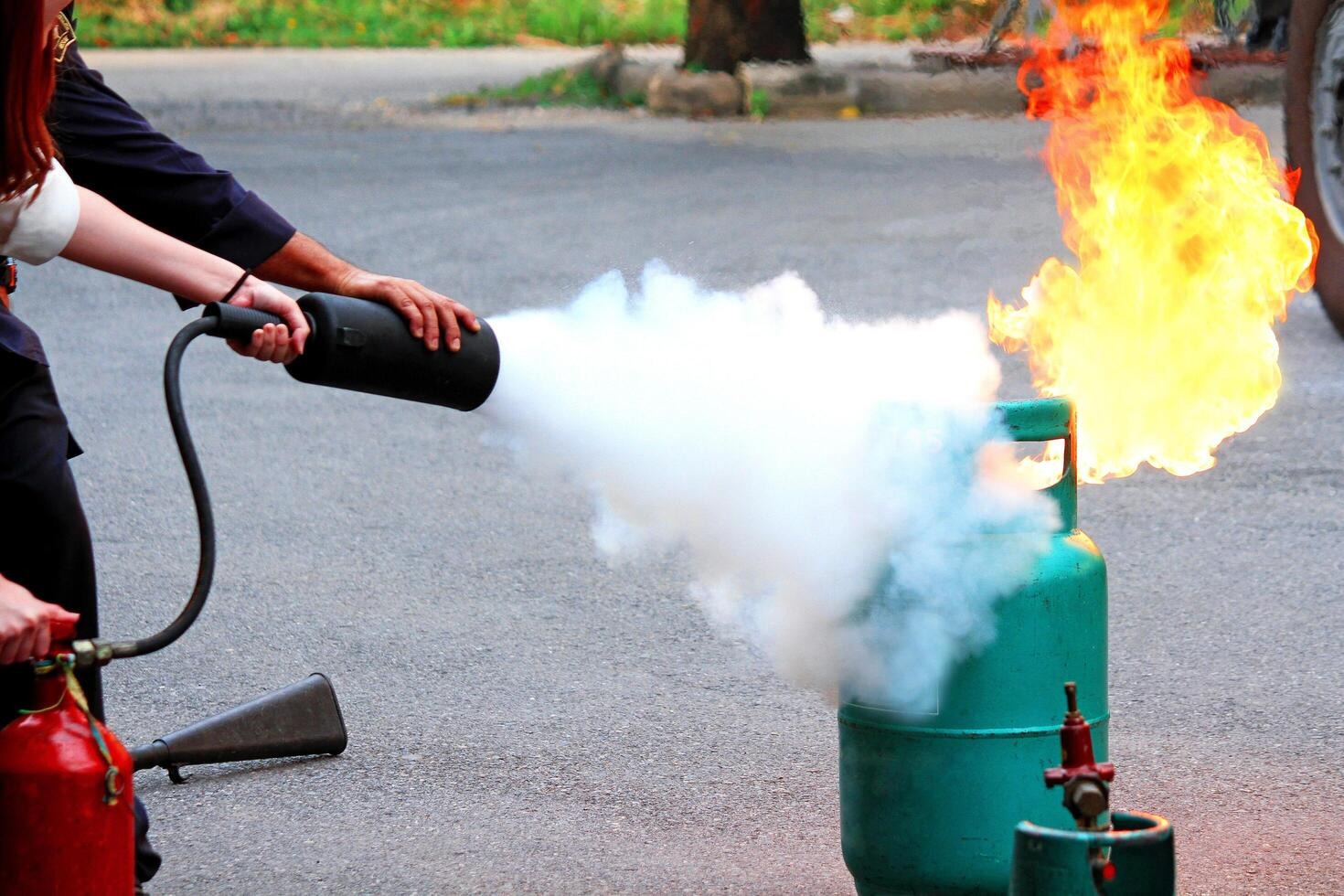
- Fire extinguishers rated for chemical fires
- Chemical spill kits
- Properly labeled, compatible chemical storage cabinets
Safety equipment should never be treated as optional or "nice to have" — regulatory bodies and most institutional safety committees treat items like eyewash stations and fume hoods as mandatory, not discretionary, for any lab handling reactive or volatile chemicals.
How to Choose Chemistry Lab Equipment: A Practical Framework
Rather than buying the most advanced instrument available, work through these seven factors in order:
- Define the application first. What will actually be tested or produced? A teaching lab, a research lab, and a pharmaceutical QC lab have fundamentally different requirements even when the underlying chemistry overlaps.
- Match accuracy to the task. Don't over-spec (a $15,000 analytical balance in a classroom) or under-spec (a graduated cylinder where a volumetric flask is required).
- Check material compatibility. Confirm glassware, tubing, and seals are chemically compatible with the specific reagents in use — this is where corrosion and contamination failures usually originate.
- Plan for capacity and growth. Buy for realistic sample volumes and near-term expansion, not just today's workload.
- Budget for calibration and maintenance, not just purchase price. An uncalibrated analytical instrument is often worse than no instrument at all, because it produces confident-looking wrong answers.
- Prioritize safety features on anything involving heat, pressure, or hazardous chemicals — this should be a filtering criterion, not an afterthought.
- Evaluate the supplier, not just the product. A good supplier provides specification support, installation guidance, and after-sales service — this is where OxyTech's role typically comes in for labs setting up or scaling equipment.
Chemistry Lab Equipment List by Lab Type
School / Teaching Laboratory
Beakers, test tubes, Erlenmeyer flasks, measuring cylinders, funnels, pipettes, burettes, tripods and basic heating equipment, balances, pH testing equipment, safety goggles, and gloves.
University or Research Laboratory
Everything in the teaching list, plus: analytical balances, pH meters, centrifuges, spectrophotometers, magnetic stirrers, laboratory ovens, water baths, and application-specific advanced instruments (GC, HPLC, or spectrometry, depending on the research focus).
Pharmaceutical Laboratory
HPLC systems, UV-Vis spectrophotometers, analytical balances, pH meters, dissolution testing equipment, stability testing chambers, laboratory ovens, and specialized sample-preparation equipment — sized and validated to the lab's specific regulatory and quality-system requirements.
Industrial / QC Laboratory
Conductivity meters, spectrophotometers, centrifuges, analytical balances, and process-specific testing instruments matched to the materials being manufactured or inspected.
Frequently Asked Questions
What is the most important piece of equipment in a chemistry lab?
There isn't a single "most important" item — glassware, an analytical balance, and safety equipment (especially a fume hood) are each essential for different reasons. A lab missing any one of the three has a real gap, not just a preference issue.
What's the difference between a beaker and a measuring cylinder?
Beakers are for general mixing and holding liquids with only approximate volume markings. Measuring cylinders are built specifically for volume accuracy and should be used whenever a measurement needs to be reasonably precise but doesn't require the exactness of a volumetric flask.
How often should lab equipment be calibrated?
It depends on the instrument, usage frequency, and manufacturer guidance — analytical balances and pH meters typically need calibration checks far more often (sometimes daily before use) than an oven or water bath. Follow the manufacturer's documented schedule rather than a one-size-fits-all interval.
Do small or school labs need a fume hood?
Any lab handling volatile, hazardous, or irritating chemicals needs a fume hood, regardless of size. The decision should be based on the chemicals in use, not the lab's budget or scale.
What glassware material is best for chemistry labs?
Borosilicate glass is the standard choice because of its resistance to thermal shock and most common laboratory chemicals, which is why it's used across beakers, flasks, test tubes, and most other core glassware.
Building Your Equipment List with OxyTech
A complete chemistry lab equipment list should be built around what your lab actually tests, not a generic template. OxyTech works with schools, universities, research institutions, pharmaceutical facilities, and industrial labs to match equipment specifications to real testing workflows — from basic glassware and balances through analytical instruments like spectrophotometers and HPLC systems — with ongoing calibration and after-sales support.
If you're setting up a new lab or upgrading existing equipment, OxyTech can help identify the right specifications for your application, budget, and safety requirements.