



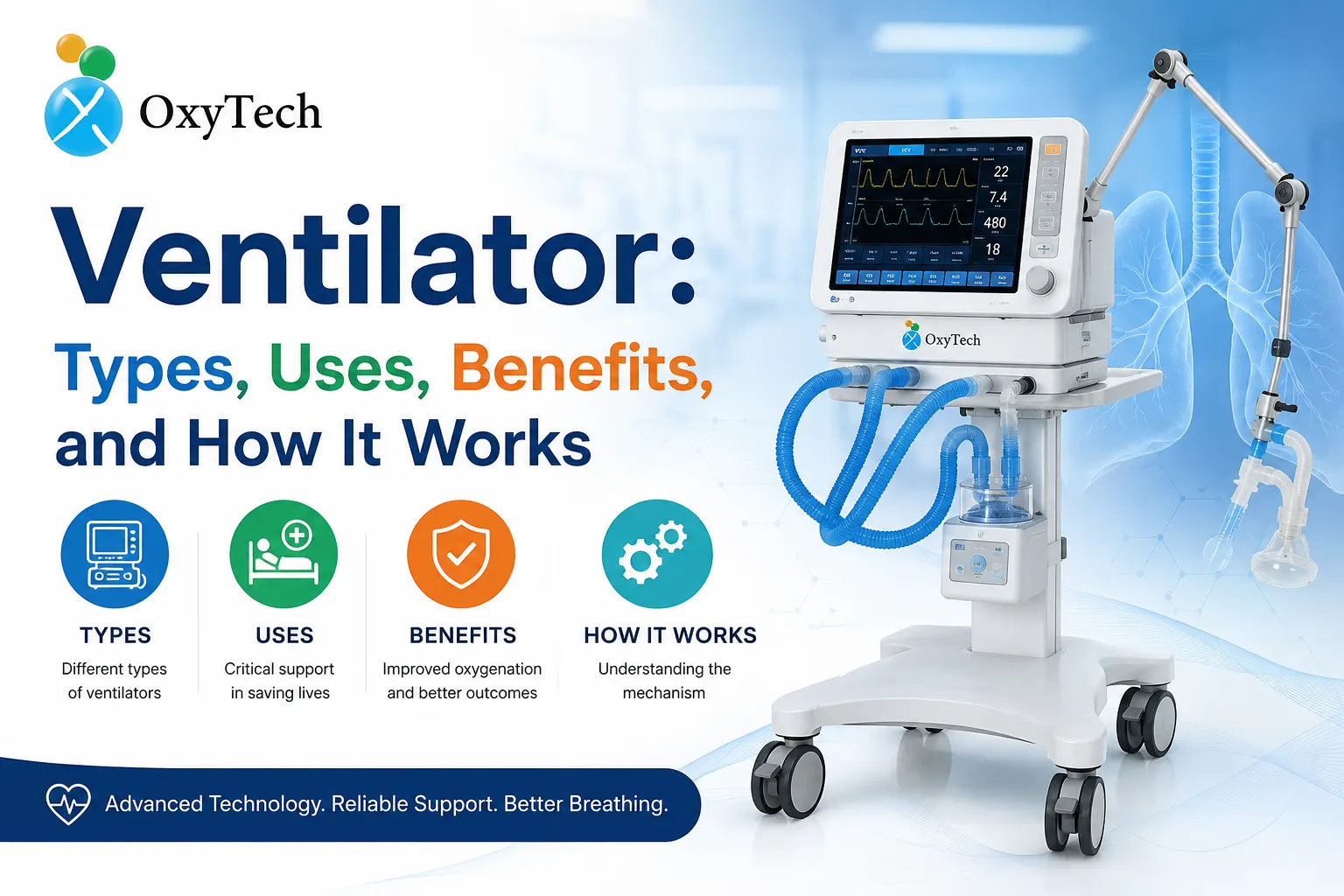
Ventilator: Types, Uses, Benefits, and How It Works
A ventilator is a medical device that helps a person breathe when they cannot breathe well enough on their own. It moves air in and out of the lungs, supplying oxygen and removing carbon dioxide. Ventilators are used in hospitals, ICUs, ambulances, and increasingly at home for people with chronic breathing conditions.
This guide explains what a ventilator is, how it works, the different types available, and their key benefits and risks — in plain, easy-to-understand language.
Medical disclaimer: This article is for general educational purposes only and is not a substitute for professional medical advice, diagnosis, or treatment. Always consult a qualified healthcare provider for decisions about ventilator use or respiratory care.
What Is a Ventilator?
A ventilator (also called a "breathing machine" or "life support machine") is a device that mechanically assists or fully takes over the work of breathing. It pushes air — usually a mix of oxygen and air — into the lungs through a tube or mask, and allows carbon dioxide to be exhaled.
Ventilators are used when a person's lungs or breathing muscles are too weak, damaged, or blocked to breathe adequately on their own — for example, during major surgery, a severe respiratory illness, or a critical injury.
How Does a Ventilator Work?
At a basic level, a ventilator works in three steps:
- Air intake – The machine draws in room air and mixes it with a set concentration of oxygen.
- Delivery – The air is pushed into the lungs through an endotracheal tube (inserted into the windpipe), a tracheostomy tube, or a face/nasal mask, based on settings a clinician programs (breath rate, volume, and pressure).
- Exhalation – The machine allows the person to exhale, either passively or with slight pressure support, and the cycle repeats.
Modern ventilators constantly monitor oxygen levels, breathing rate, and lung pressure, and can automatically adjust to match the patient's needs or alert staff if something changes.
Types of Ventilators
There are several types of ventilators, each suited to different medical needs.
| Type | How It Delivers Air | Common Setting | Typical Use |
|---|---|---|---|
| Invasive Ventilator | Through a tube inserted into the windpipe (intubation) or tracheostomy | ICU, operating room | Severe respiratory failure, surgery, coma |
| Non-Invasive Ventilator (NIV) | Through a face mask or nasal mask (e.g., BiPAP, CPAP) | Hospital ward, home | Sleep apnea, COPD flare-ups, mild respiratory distress |
| Portable/Home Ventilator | Tube or mask, battery-powered | Home care | Chronic conditions like ALS, muscular dystrophy |
| Transport Ventilator | Tube or mask, compact and rugged | Ambulance, helicopter | Moving critically ill patients |
| High-Frequency Ventilator | Very small, rapid breaths | Neonatal ICU | Premature infants with underdeveloped lungs |
Invasive vs. Non-Invasive Ventilation
- Invasive ventilation requires a tube directly into the airway and is used for the most severe cases.
- Non-invasive ventilation uses a mask over the nose or mouth and is less risky, used for milder or short-term breathing support.
Uses of Ventilators
Ventilators are used in a wide range of medical situations, including:
- Respiratory failure from pneumonia, COVID-19, or other severe lung infections
- Major surgery, where anesthesia suppresses natural breathing
- Chronic lung diseases such as COPD or pulmonary fibrosis
- Neuromuscular conditions like ALS or muscular dystrophy that weaken breathing muscles
- Traumatic injuries affecting the chest, brain, or spinal cord
- Premature birth, when a newborn's lungs are not fully developed
- Sleep apnea management (typically with non-invasive devices like CPAP/BiPAP)
Benefits of Ventilators
- Life-saving support — keeps oxygen flowing to vital organs when natural breathing fails
- Buys time for recovery — allows the body to heal from illness, injury, or surgery
- Reduces strain on the heart and lungs — by taking over the physical work of breathing
- Enables safe surgery — allows anesthesia to be used without risking suffocation
- Supports long-term chronic care — portable and home ventilators let patients with chronic conditions live outside the hospital
- Precise, monitored care — modern ventilators continuously track oxygen levels and adjust automatically for patient safety
Risks and Considerations
While ventilators are often life-saving, they are not risk-free. Potential complications can include:
- Ventilator-associated pneumonia (infection risk with prolonged intubation)
- Lung injury from excess pressure or volume
- Muscle weakness from prolonged immobility
- Discomfort or need for sedation with invasive ventilation
These risks are why ventilator settings are carefully managed and continuously monitored by trained clinicians.
Ventilator vs. Oxygen Concentrator: What's the Difference?
A common point of confusion:
- An oxygen concentrator simply increases the oxygen concentration in air a person breathes on their own.
- A ventilator actively does the work of breathing — pushing air in and out — for patients who cannot breathe adequately by themselves.
Frequently Asked Questions
What is a ventilator used for?
A ventilator is used to help or fully take over breathing for patients who cannot breathe adequately on their own, such as during surgery, severe respiratory illness, or critical injury.
Is a ventilator the same as a CPAP machine?
No. A CPAP machine is a form of non-invasive ventilation mainly used for sleep apnea. Hospital ventilators are more advanced and can fully take over breathing for critically ill patients.
How long can a person stay on a ventilator?
It varies widely — from a few hours during surgery to weeks or months for severe illness. Prolonged ventilation carries higher risks, so doctors aim to wean patients off as soon as it's safe.
Can a person talk while on a ventilator?
Patients with an invasive tube through the mouth or nose generally cannot speak, since the tube passes through the vocal cords. Those with a tracheostomy and a speaking valve may be able to talk.
Are home ventilators safe?
Yes, when properly prescribed and monitored. Home ventilators are widely used for chronic conditions and are managed with training, regular check-ups, and clinician support.